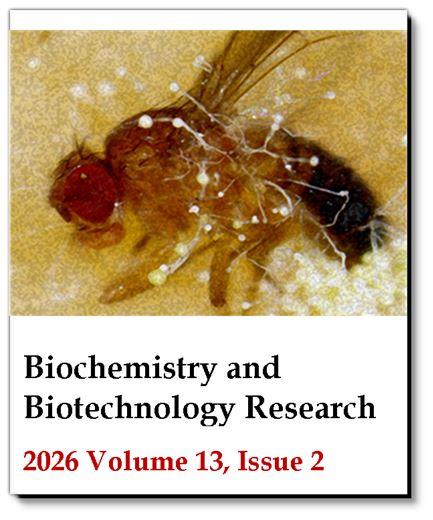
Antifungal potentials of 2,4-dichlorobenzyl on Aspergillus species using Drosophila melanogaster (UAS-Diptericin) as a Model
Williams Ghate Burke, Ikoni Joshua Ogaji and Ponchang Apollos WuyepBiotechnology and Biochemistry Research
Published: July 14 2026
Volume 13, Issue 2
Pages 12-18
DOI: https://doi.org/10.5281/zenodo.21356769
Abstract
Antimicrobial resistance (AMR) is one of the most significant global public health threats, reducing the effectiveness of existing antimicrobial agents and limiting treatment options. Furthermore, many currently available antifungal drugs are associated with adverse side effects. Consequently, the development of new, effective, and safe antimicrobial agents is essential. Drosophila melanogaster (fruit fly) has become a valuable model organism in biomedical research because of its genetic tractability, short life cycle, and availability of advanced genetic tools. This study evaluated the antifungal potential of 2,4-dichlorobenzyl against Aspergillus species using D. melanogaster (UAS-Diptericin) as an in vivo model. The purified 2,4-dichlorobenzyl compound was obtained from the Department of Chemistry, University of Lyon, France. Antifungal susceptibility was assessed using the agar well diffusion method, while the minimum inhibitory concentration (MIC) and minimum fungicidal concentration (MFC) were determined using the broth dilution method. Flies were infected with different Aspergillus species through ingestion and treated with diets containing varying concentrations of the purified compound or itraconazole (100 µg/mL). Survival was monitored for seven days, and mortality was recorded. The purified compound exhibited concentration-dependent antifungal activity with varying efficacy against the tested species. Aspergillus terreus was the most susceptible, with inhibition zones ranging from 11.90 ± 0.27 mm to 31.33 ± 2.40 mm, followed by A. niger (10.67 ± 0.67–30.30 ± 0.76 mm), while A. fumigatus was the least susceptible (4.27 ± 0.18–24.23 ± 0.92 mm). MIC and MFC results supported these findings, with A. terreus exhibiting the lowest MIC (20 µg/mL) and MFC (40 µg/mL), followed by A. niger (40 and 60 µg/mL, respectively). Survival analysis showed significant differences among treatment groups (P ≤ 0.05). At 100 µg/mL, the purified compound produced survival rates of 81.39% and 73.91% in flies infected with A. niger and A. fumigatus, respectively, compared with 86.67% for itraconazole. However, survival of flies infected with A. terreus was lower (31.11%) than that achieved with itraconazole (86.67%). These findings suggest that 2,4-dichlorobenzyl possesses promising antifungal activity against Aspergillus species and that duplication of the chlorine atom on the N-benzyl group enhances its antifungal efficacy.
Keywords: 2,4-dichlorobenzyl, antifungal activity, Aspergillus, Drosophila melanogaster, survival rate.
Full Text PDF